Showing posts with label Inspiration for Writers. Show all posts

Sunday, November 24, 2024

They Say You Learn About Yourself by Writing

This blog generally grows from a wisp of an idea. I'm coming at it today wondering if anything can be learned personally from having blogged now for over a decade. I think that might be better left to a psychologist, or maybe now an AI program that can analyze patterns in writing. A word cloud, perhaps?

Overall, there's a thread here. I aim for the inspirational, when in fact my writing life right now entails little more than some personal journaling. I'm not a quitter, but my fiction output has been next to nothing for more than a year. Life gets in the way, I could say, or lean on some other trope: you'll bounce back, just take a pass, it's a phase, better luck next time. Whatever.

This doesn't feel like writer's block. It feels more like a writing seizure. Is there medicine for that? I woke up one morning this week and realized it's November, the month for the fun group novel-writing sprint, NanoWriMo, National Novel Writing Month. But even NanoWriMo has been having some pain-points. Still, I used to highly anticipate participating in the community-wide event to produce a novel in 30 days. I totally forgot about it this year.

2024. Boo. I could chalk up my seizure to this shitty year. Events went from bad to bad. Without getting into the terrible details, the year comes to an end after a major weather disaster where I live, just one of the many doggie downers. 

What am I learning from writing this post? An overall feeling that it is time to hang up this blog. That's not what I was thinking when I started this post. I've used this space to kinda think out loud, be the courageous seat-of-my-pants blogger-type, and drive some audiences to my work. But I don't often take my own blogging advice. Writing is a damn hard way to live. It's subjective and strange and solitary. The longer I type right here, the more obvious it seems that this is a good time to say good-bye to blogging and feel okay about it.  

So, wow. This post brought on what was bubbling underneath. A feeling to let go. 

This is good. This is good. Space opens up to do something else. 

You're great for having hung out with me over the years or for reading me for the first time. Browse old posts if you want. Thanks for reading me, at all. Thanks for commenting, if you did.  

Best to you. Hug your people. 

Sunday, February 27, 2022

The Hieroglyphics of Notebooks

My first serious writings go back to childhood when I kept diaries and wrote letters by hand. I loyally (well, as much as a pre-teen can) wrote to various pen pals, like my grandmother, and then sporadically used small diaries, secured by tiny locks and keys. I was a better letter writer than a diarist. My early attempts at journaling in the diaries show my self-consciousness. It still feels self-indulgent to write about myself. But, welcome to my blog (ironic wink here😉).

What I appreciate about those early writings is the demarcation of time. My age, the date, my thoughts show where my head was at. You can image at 12: "No one will ever love me for X, Y, Z reason!" Ouch.

I stopped journaling in high school and college. It wasn't until about ten years ago that I took up writing to myself in random notebooks, but those were mainly to start the novel I couldn't get out of my head. I'd take the kids' abandoned Pokeman spiral notebooks from school and re-love them. Then friends, my husband, other writers, started giving me tiny journals. I have a nice collection. I didn't become suddenly prolific though. Maybe I became more diligent at jotting the occasional gem of an idea down. There was also an index card phase (which I've recently revived), and I was not above using a crayon.

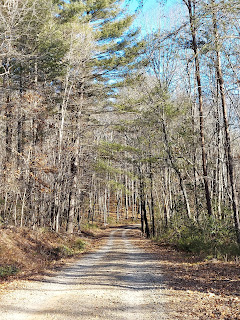
Path of hike in North Carolina

By no means do I have an astounding collection of handwritten work. What I do have are snapshots of the past. They tell me who I was at a time when I was wondering who I was. Sometimes, more often than I'd care to admit, my writing didn't go much beyond "no one will ever love me" (no winking here).

Recently, I flipped through a notebook in my drawer and picked a nearly blank one to find a poem I couldn't remember writing and the title of a book, which I've since read. Both notes to myself were several years old, both a remembrance of what was going on then, the life stuff, the good and the bad. Ironically, I just mentioned the name of the book to someone and went on to describe the gist of the story, which was darkly dystopian.

My point is: notebooks are like hieroglyphics, and mine are a mirror. Sometimes it's nice to see your old self; sometimes I wish I looked different.

Sunday, May 2, 2021

Make Room for Headspace

For years, I've been whispering into my own ear: "Go on a retreat." Several of my more intuitive and spiritual friends plan them routinely, sometimes more than a few times a year, to get out of their heads. Frankly, for me, making time to make time is a little like digging in sand. 

I bump into myself regularly trying to commit to stretches of only writing. When brilliant flashes of freedom tempt me, it doesn't take long until I'm cleaving to door jambs, afraid to leave the chores undone and the cats to their own devices. But streaks of creativity don't just spontaneously happen. You plan them; or, you practice them. Otherwise, you just aren't productive. 

The added bonus of going away from home is finding inspiration. I went away for a few days recently and, even though my wordcount was low, the rejuvenation factor was high. The trip reminded me of the importance of making room for headspace, because writing is a head thing. Even if speech-to-text becomes more universal, thinking is an essential ingredient to crafting a story. Thinking without a cluttered mind and surroundings (bills, dust bunnies, laundry) can be priceless. 

Let me show you where I went. And, I'll be upfront that the hosts of the Inn on Mill Creek in Old Fort, NC, generously gifted this trip. I'm sincerely grateful for their hospitality. It's fitting that the materials promoting the Inn include quotes from writersJane Austen, John Muir, Robert Frostbecause this place is suited for solitude and contemplation. The number of places on the property where peace and quiet are available is much longer than my favorites list.

Best Spots at Inn on Mill Creek for Writers

#1 The desk in the shared TV room of the Deck House. I was lucky enough not to have to share the TV room with anyone because of renovations. But, you can see why this hovel screams WRITE! Apparently, I'm not the first writer to think this spot is the bee's knees. It overlooks a water feature.

Writer's Desk at Inn on Mill Creek in Old Fort, NC

#2 The deck off of my bedroom. Brigette Walters, who's an innskeeper, told us that the adjacent lake and wetlands sound like a meditation app. No kidding.


#3 The boardwalk. This marvelous area emerged recently from the handiwork of Brigette's husband and co-innskeeper, Dave. Dave's a retired engineer who decided in late 2019 to build a floating boardwalk over a wetland area on their seven private acres. He finished it in about five months, constructing 10 feet at a time. It's an amazing addition to the grounds, and I didn't spend nearly enough time on it. I'm going back when he adds the bell, hand-crafted from an old fuel tank. BTW, the seats in the magnolia tree are placed in the exact spot where Dave got the inspiration to build the boardwalk in the first place. Dave, you're cool!


#4 Brigette's gardens. Brigette loves plants and birds and people. She even recognizes a few of the squirrels, who she admonishes when they visit the birdfeeders in the garden near the breakfast solarium. It's okay, Brigette. We'll wait for the hummingbirds. 


This place makes a writer wanna go Thoreau: just slip into the woods and not come back. Maybe next time, I won't.

Sunday, December 13, 2020

Advice for Becoming a Writer

Photo of Northern Lights by NOAA

Looking back in the 10-year rearview mirror, here are some lessons learned about writing fiction. If you're new to "creative writing" and want to make a name for yourself or switch careers, let me clue you in:

  • If you're not reading, you won't make it. Not only must you read in your genre and good books in general, you should be reading ABOUT your genre and WHY books are good. Not only must you keep learning how to write better, you should be practicing what you learn. Not only must you market, you should be dedicating time to marketing, because in a larger sense, that's the only way anyone will ever see your work.
  • Don't bank on making a living by writing fiction exclusively. Despite that statement's negativity, it's realistic. If you put that kind of pressure on your creative life ("I must be a bestseller by XYZ or write the Great American Novel before I'm 30"), you will find all kinds of stresses will invade your psyche and take the joy out of creativity. 
  • Keep earning a steady source of income, even if it isn't writing and even it if cuts into your writing/creative time. Having resources for food, water, shelter gives you the headspace (and physical space) to write. If you love writing enough, you will continue to write regardless of having a day job, and your writing will reward you in ways other than financial. Can you make it "Big," whatever "Big" means to you? There's always a chance.
  • Break the rules, but know what they are first. This goes back to the advice: Keep learning.
  • Just because you write it, doesn't mean they will come. Readers and sales don't flop in your lap.
  • Your work isn't for everyone. That's okay. In fact, if it was liked by everyone that would be an anomaly the likes of an asteroid hitting Earth. Carve out a niche for yourself. If you want to be market-savvy, then hyper-focus on trends and popular tropes in your genre. Or, if you're like me, experiment. There's richnesses in following your own muse.
  • Your creative life is yours and yours alone. You don't have to live it any way but your own. If you find success with one piece and like the success enough to repeat it, then follow that path. If you never want to write another story like it again, then don't. You're the master of your spirit. Follow your spirit.
  • Have some FUN in your creative life! Do something that puts you out in the world (virtually, these days, of course). Make people smile, and the act will reciprocate.


Sunday, December 22, 2019

How to Be Connected but Disconnected

My tracking device, that is my smartphone, got a good talking to today. I told it, Hey, listen, I'm putting some limits on this knowing-what-I'm-up-to-every-sec-of-the-day routine. I suppose the steps I took to undo my location finder (at least) will help a fraction from my info being bought and sold in an unseen exchange within a dark transaction void used by the multi-national corporations.

This romantic notion that I can somehow spare myself and my children from become marketable data or monitored targets may be a little futile. I frequently wonder what it would be like to go "off-the-grid" entirely. The grid just sounds like a torture machine. There's a certain allure to living so independently from everyone and everything "connected." People write books about disconnecting. I have several friends who have tried it or are nearly disconnected. But in truth their lives seem more connected or tuned to other things, mainly nature and art. They're doing the modern version of Walden Pond.

It's an American ideal to do everything yourself, on your own, those proverbial bootstraps. I'm not talking necessarily about living without running water or electricity. My friend who tried that on the Kansas prairie ended up retrofitting his house when he got remarried. Let's face it, we want to be comfortable.

But do these crazy smartphones of ours, that have more computing power in them than was available on the Apollo 13 mission, give us the comfort we really desire? I'd argue no. Yet I spend far too much time on my phone, and if I can't look at the notifications or check the temperature or use my calendar, I get a little agitated. The computer engineers designed them that way! Miss me when I'm gone. It's a strange feeling now to walk around without one. Maybe I need to spend a few days away from it. Maybe a few weeks. Maybe forever? Maybe I'd write more. I'm pretty sure I'd still be living and breathing and enjoying the world without it.

Monday, September 16, 2019

Birthdays Last Forever

This post is six in one. I'm one of those rare people who, as she ages, appreciates her birthdays more and more. They are a happy, motivating force. So, I've been writing short essays for my Birthday Week on Facebook the last few years. Here's the 2019 set. Enjoy!

Not Sucking

The day she removed the note from her refrigerator door reminding her not to suck—a note that met her each morning as she pulled the creamer carton from the clear plastic shelf knowing she would feed the cats first—she decided that “not sucking” was far too low a bar to set. The opportunities for an employed American woman with a low mortgage interest rate and a high credit score afforded her options much sweeter and exotic than surviving the day without feeling like she owed someone something or had screwed up that one important Thing-I-Will-Do.

No. She was not sucking. Not anymore. She was ! so ! not sucking that the conceit of the idea suggested a need for pity. Sure, she’d had her challenges: a dead husband, a steep learning curve into single parenthood, a stuttering career that had placed her in late middle age skating along the edge of under-employment. And her lovelife. Yes, the men. Sigh. How could she truly discern which of them didn’t suck, the few who had brought a minor twinkle to her eye. Hell, all she wanted was to be held and told “It’s not all going to suck.”

She was going to have to give the not-sucking pep talk to herself. No one else would do it less-sucky. It needed to come before her coffee. Before the cats. Before the shower for work. Before she dealt with the kids. Before she kissed the next man. Before she wrote yet another essay in third person. Before she opened the chapter to another year of not sucking. “No, my dear, you’re not sucking. Everything that could possibly suck, has. Now, get on with it. You’re fabulous.”


Dear Hands

Dear Hands:
Where have you been all my life? In front of me, that’s where, like a guiding, driving force. Can you remember holding anything for the first time? My mother’s finger in your tiny baby palm? And what about a Cheerio or your first ice cream cone? Mouth loved those so much.

Did you think holding Dad’s hand was special when you needed to get up and walk for the first time? Feet were always one step behind you. They would never hold a Crayon or shuffle a deck of cards.

And, then, one day, you wrote! It was you and Brain from then on—attached at the hip (haha). You were Brain’s tool. He told you what to write and when and how, and in your wish to comply, you wrote all those long handwritten letters to your great-great long lost aunt whom you never met and to your Gramma Mimi and to your cousin, whose letters you stuffed into small white envelopes and sent with God knows what inside.

You learned to write a lot of big words and to erase a few, too. No one was really looking at you or the rest of us either. It didn’t matter much whether we got any attention, and it didn’t make any sense to complain. It was easier to go to the cupboard for a cookie.

But, then, the typewriter!

Who was our first typing teacher? Maybe Mrs. Lane, a large Nordic-looking woman who gave us spiral-bound practice books to complete mindless exercises. Ff, Jj, Kk, Ss, and did you know there were so many other sentences that used the entire alphabet other than “The quick brown fox …”? Me neither.

You really were a showoff, Hands. You knew how to fly across those typewriter keys and kick the hell outta QWERTY. The IBM Selectric was a goddess of a machine. Maybe after her we just didn’t care for pencils anymore.

And then you got really snotty in college as the typesetter for the student newspaper. But Brain wouldn’t have it. He wanted YOU to write, not just decode everyone else’s writing for the weekly rag. Did typesetting feel like second-class citizenry? Never mind, because you turned into a journalist. Yet, come to find out, you weren’t quite fast enough at note-taking. The tape recorder took over your scribbling job. You spent years afterward as a glorified transcriptionist. Don't worry, we appreciated the effort.

Your dexterity came in handy later. When the smartphone showed up. Lord, what would we do without Thumb?! The master of all texting. A savior. A god.

Let me say, all that transcribing and gophering for Brain hasn’t quite been the pinnacle of your life. In fact, those things you wrote were third-string compared to the important stuff.

You held my babies and never failed.
Cuddled their precious new skin.
Nestled hunger against my breast.
Stroked tufts of hair freshly washed with Johnson & Johnson.
Delivered electric love with a fingertip on a teary cheek.

And wasn’t THAT something?
Something worth writing about.

(Thank you, Nina Hart, for inspiring Dear Hands!)

This Lil Monster Love

(Last year, after posting some of my Birthday Week essays, several friends commented that the pieces seemed kinda sad. That wasn’t my intention when I wrote any of them, and I assure you I’m not sad writing any this year. So, please don’t worry. I’m okay. I am. If anything, I’m 100% human. Always agitating for more. 😎)

The word—get—is not my favorite. It’s guttural and sounds like it’s picking a fight: Get XYZ. I need to get XYZ. If I don’t get XYZ, I’m coming to get you.

But, we don’t always get what we want, thanks Rolling Stones. Beyond food, clothing, shelter, the necessities, getting what we want all the time, all the way, just doesn’t happen. Let’s call those our Lil Monster Needs.
Lil Monster Needs will keep you up at night.
These Lil Monster Needs could fill a garbage bag a week. If you believe in religion, you might advise us, the keepers of the Lil Monsters, to go in peace. Peace be with you .. and your bagful of Lil Monsters. Drop them off along the street corners, maybe, in black Hefty garbage bags where they can slump next to the other bags o’ Lil Monsters in the neighborhood, forming rows of holes to be filled. Then, the garbageman might come along on his Monday route and find that he can’t fit all the Lil Monsters in the back of his dumpster. Where will they all go, still calling out to their owners, who can hear them quite crystally clear from their dining room tables next to the picture windows with the blinds closed?

One need in my bag calls out particularly strong from its pre-final-resting-place at the bottom of my driveway when I place it there each week. Its voice could travel a hundred-thousand miles or from a dirty ditch three counties over and be flattened by bulldozers five times a day and covered by a layer of dirt, but still I’d hear.

‘Feed me love,’ it says. And not just any kind of love, but an expansive, immortal love for which there may be no source. It is a hungry, greedy need—this Lil Monster Love—whose teeth have some mighty sharp ends. It knows how to get me. And maybe you, too.

Bury it where you’d like. It’ll find you anywhere you go.

Ghost Riders

Two years ago this week, I decided to reaquaint myself with bicycling. I’d been off my bike for about 15 years. Bicycling had become something I’d do at the beach or on a special outing. When I lived in Portland, the biking capital of the U.S.A., even then, I hadn’t been a serious rider. But I wanted to make a lifestyle change and contribute to Asheville’s shift toward becoming more bicycle-friendly.

It took a leap of faith to overcome my fears of biking in a hilly town where there aren’t a lot of bike lanes. Asheville’s population is about 91K and is surrounded by the Smoky Mountains, so it still has a lazy feel to it compared to Portland or Austin, Texas, cities that are often considered its contemporaries. Biking has been slowly taking hold here, and I’ve started riding at a time when a small but growing band of others are, too. In many respects, I see this as my effort to “be the change you want to see in the world.”

What I didn’t anticipate when this adventure started was how biking is both a solo venture and a ride-along. Not that I’m commuting with a bunch of folks or organizing group rides to promote the culture here. My companion riders aren’t really real. They’re all people—living and dead—and memories, just a few ghosts that tag-along in my head.

I’ll admit, the number of streets I’ve been on continues to expand and so do my ghost riders. Here’s one: my 12-year-old self, who used to ride from Franklin Street in Clinton all the way to Artesian Park for swim team practice. My old high school friend (now a ghost rider), Maria, and I made those trips together, and once I ran into the back of her bike and flattened her back tire. Her dad called me Crash Fulford after that. Thank goodness I haven’t lived up to that name. But pre-teen me is frequently on my rides.

One of my first ghost riders, obviously, was Daryl. He’s most vividly with me when I’m on a trail. There’s a short urban trail about a mile from my house, and almost every time I’m on it, I think of his last ride. He was mountain biking near Portland when he passed away. He became short of breath and stopped to rest. He sat down at a wooded spot and lost consciousness from heart failure. A friend, Ethan, was with him. He rides with me, too. For Daryl’s funeral, friends marked the spot on the trail by nailing a bracelet that Daryl had made to the tree he was near. It’s simply engraved “LIVE.”

A man I never knew, Ray, rides with me because I inherited his bike. He was a friend of a friend and a rider in Asheville, way before me, and he died not too long ago. I’d been searching for a commuter bike when I was told his family wanted to re-home his. I met his grown daughters shortly after his death. They had that look about them that I had when Daryl passed, stunned resignation. I was thankful for the affordable option their dad’s Diamondback gave me, and it’s been a solid bike on the street and gravel. Thank you, Ray. I appreciate the loaner.

Another tag-along, my daredevil side, also rides along. Darn it if I can’t shake the desire to speed. I always do my best to stay safe, but the thrill-seeker in me can get a little itchy. I ALWAYS wear a helmet and almost always a safety vest and carry lights in case the sun goes down. So, there’s that.

My teenage kids ride with me, too, in spirit, as do many friends, co-workers, and acquaintances who often want to know about my riding adventures. Riding a bike is an adventure for people who don’t. I always see something I wouldn’t if I were in my car. Just a few days ago, I saw a public mural I’d never noticed on a building in the middle of town. How could I miss it? Because driving just does.

I’ve been on hills and trails and sidewalks and bike lanes and neighborhoods and parks. When I’m in my car for other commutes, almost always I’ll drive down roads that I’ve now cycled on. My cycling has criss-crossed the city and its bumps.

One street in north Asheville passes by the location where Zelda Fitzgerald, wife of F. Scott Fitzgerald, spent time in a home for mental health patients. It’s a scenic and hilly spot and not a place that anyone would necessarily say, “Let’s ride there.” It’s off the beaten path. And I always think: Wow, she lived here. She slept and ate and maybe wrote here. Though her husband earned the notoriety, she was also a tremendous writer and, from what I’ve seen of her work, had an incredible knack for words and story. Unfortunately, she also died in the institution during an accidental fire in 1948. I can’t help but wonder if maybe her ghost is sweeping across the grounds when I ride by. Out of deference, I nod my head occasionally. One free-thinking woman writer to another.

A Master

It's late and dark out, and I owe myself an essay. Not you, me. I want to write Birthday Week Essay #5 because it compounds the doing. Here’s where a self-reminder helps. The product of this week is not in the numbers—the word count or the days in a row that I can dash off something worth reading. I tend to become wrapped up in the product, the outcome. What do I have at the end? Something I can sell? Something I can point to of publishable quality in the competitive world of literary works? Something that drives my friends, family (you!) to buy one of my books? I’m not writing any of these essays for those reasons. I’m writing because of the love of the doing. I celebrate my life by doing this thing I love.

I’ve taken enough writing classes and practiced to a degree that I understand doing is good in and of itself. This is not the same as mastery. At one class years ago, with a best-selling memoirist (I may have the details wrong), the message she drove home was: the only way to become a master writer was to write for 10,000 hours. Where she got that figure, I don’t know. That comes out to be about 20 years of 40-hour work weeks. At that rate, I’ll never be a master writer. I’ll always be a doer.

In retrospect, what do we ever master when the bar is so high? For me? Naturally, there are a few things. Some good, some unfortunate:
Worrying, that evil energy-suck.
Breathing, thank God.
Eating, the great necessary indulgence.
Sleeping, though losing the skill to age.
Failing, this essay, perhaps.
Wanting, always always.
Caring, about my family, friends, the planet.
Hoping, never caving to the dark.
Learning, by the doing.

I’ll keep doing this, if you promise to keep doing the thing you love. What do you love? Go do it.

WWJFD

Remember that craze in the 1990s that had millions wearing rubbery bracelets marked with WWJD? The What Would Jesus Do? message essentially was: do good works and act morally as a demonstration of Jesus. I never quite caught the fever. But in the last few years, as I’ve navigated solo-mom duties and faced a lot of consequential decisions alone, I’ve come up with my own coping mantra: What Would Jack Fulford Do? Or, for short, WWJFD.

Jack Fulford, my father, happens to be salt-of-the-Earth stock whose moral and intellectual compass closely matches mine. I guess that shouldn’t be any surprise. All bias aside, I’ve come to understand that practicality and common courtesies are a little scarce these days. The world isn’t such a nice place on the other side of my front door. Now, you’re probably thinking: ‘She’s paying tribute to her father because that’s what a grateful daughter would do in some fashion once they meet a certain age.’ True, to some degree, and as I celebrate another birthday, my age does instill a smidgen of perspective.

Yes, I love my father. He’s a decent man with decent morals and a sense of wonder and a little bit of compassion that hasn’t been killed off by cynicism. But, he is human. He’s got his faults, too. He’s sometimes slow to motivate, more of a plodder than a sprinter on decisions and actions. He deliberates occasionally with the speed of Chicago rush-hour traffic. You just gotta wait it out. That isn’t to say that he doesn’t have his share of bright ideas that, when executed, tend to look a little impetuous to an outsider.
For instance, on a recent flight of mine into KC International Airport, he showed up in an old Honda Acura, having just bought it for the visit. It was an impulse buy, by most standards, out of convenience. Rather than haul me and his grandchild around Missouri in the cramped cab of his Chevy pickup with our baggage thrown in the truckbed, he’d opted for second-hand luxury. Family required a trunk and a backseat, so we piled in (albeit, after we stood for a good five minutes in the parking garage trying to figure out how to turn off the car alarm).

A year ago in July, Dad and I went on a two-day, two-night excursion on an Amtrak train across the West. We’d cooked up the idea after my first train trip earlier in the year. We both reserved sleeping berths that included meal service in the dining car. And from Denver to San Francisco, we basically spent the entire time talking. It was an unbelievably precious 48 hours. In those two days, we commiserated about the past, about politics, about books, about people, and the funny and tragic circumstances that glued our family together. We watched incredible scenery roll by and passed through historic locations (site of the Donner Party) and natural wonders (the Salt Flats). Pauses in our conversation, when we had any, were always a segue to a new subject. We smiled and laughed a lot and wondered with grave concern what the future would bring, for us, for our families, for our country. We met some interesting characters on the train, people we would have never encountered elsewhere (a young man who sang in the San Fran Opera and his artist girlfriend), and left each other with new stories to tell. Storytelling is a good skill to hand down. It centers you to your people.

Obviously, my gratitude for that trip is immense. For those of you who’ve lost your father, I am so incredibly sorry. This includes my own children, who will not have the opportunity to spend time with their dad in adulthood. For those of you who do not have a relationship with your father or parents, my well of sympathy runs deep. I am fortunate. Looking ahead, there are still plenty of blindspots. There’ll be more days of decisions that are tough and that I’ll feel ill-equipped to handle. But, I’ve got my backup. WWJFD.

~end~thanks~for~reading~


Sunday, September 16, 2018

Askance at a Celebration

Only a writer would make writing prompts a fun birthday activity. But they were for me last month when I decided to write brief essays leading up to my day. Funny, though, a few friends on Facebook, most of whom know me, gave me some surprising feedback. I didn't necessarily feel like these were a downer when I wrote them, but several readers took them that way. Wasn't my intention. These are reflections on good stuff with reality woven in. Five in total.

#1, The Bike of Second Chances
Woman walks into a bike shop. Tiny place. Two rooms. Shiny bikes. Fresh gear. Two men behind the counter. A mechanic and a counter guy.
Her bike is 30 years old. She’s sure it needs a tune-up. Probably worse. She almost trips rolling it in. She braces for the up-sell.
My antique.
“Look at that,” the mechanic tells the counter guy, maybe even elbows him. ”You got one just like it.”

“A Cannondale?” she says, not sure to which guy. “It’s kinda old.”

“Jesus, and roller-cam breaks.”

Should she blush? Are they admiring it? Or amazed it’s still in one piece?

“I wanna start riding it more,” she says. “I just need to make sure it’s ready.”

The counter guy wheels it behind a glass case full of sparkling objects that would probably make her ride faster, go farther, look far more hip than she does on her one and only mountain bike. Her first real boyfriend helped her buy it before she knew what mountain biking was, before she had a mortgage and teenagers to raise by herself. Parenting pushed the bike to the recesses of the garage, and then life pushed everything else into the recesses. She wanted to come out of the recesses.

The mechanic lifts it up on the bike bench right away. She sucks a little air, like she’s watching her cat at the vet poised for an examination.

Thinking it might be better to look away, she wanders into the store, hoping the mechanic will be gentle when he delivers the bad news. Oh, he’d say, your axle is shot. Geez, he’d point out, these gears are stripped. No way, he’d admonish, should you ride this old thing on the street.

“Hey,” he calls back, within maybe three, five minutes tops. She hustles over, stiffens her neck. “Nothing really wrong with it,” he says. “I’d say, ride it ‘til the wheels fall off.”

A year later, the bike’s on the street, and she’s on the bike, rolling out every wrinkle.

#2, The Mysteries of Family Ephemera
Pearly whites.
Mom's always had a killer smile. Must of smitten Dad pretty good, so much so he worked hard to beat out his best friend, Freeman, who was dating Mom first. Dad took lots of pictures and slides back when he wore sideburns and horn-rimmed glasses. I've got a picture or two of him, packed away, looking all James Dean. Not sure who took the pictures of him. He took this picture of Mom, I think when they were still dating. She just turned around someplace outside on a Missouri afternoon, where they were together one day, and he caught her full-on happy. The precursor of a selfie. She still smiles like that, on occasion.
The Elmores.
My other family photo shows Dad's side of the family. On the front row, seated far left, is Pearl. She was still alive when I was a kid visiting Lebanon, Mo. Aunt Pearl was how I knew her, but my memories were just from an 8-yr-old point of view, and everyone then seemed dignified. Right above Pearl, my Dad has told me, stands Mabel. The story goes that Mabel was a bit of a playgirl and fancied herself a few boyfriends. She never married. I'm feeling (channeling?) ya, Mabel. But I'm getting a late start.
If you look hard enough, you can see my reflection in the glass of the group picture. Wonder if someone will be writing about me to hundreds of acquaintances in a few decades?

#3, Life on a Train
Somewhere in Colorado.
Life on a Train
...slows waaaay down
...shreds your cell service
...causes you to revive that spectacular-crazy idea you've put on hold for too long.
Outside the Train
...the landscape is grass, snow, mountains, the horizon
...scenery you never thought existed
...and an ongoing rumble
Life on a Train
...goes on hiatus for a while
...places you at the mercy of the American railway system, and despite its potential, A-types will mutiny, screaming for a rental ride rather than a cheap bottle of wine in the bar car
...opt for the bar car.
The Train Stops
...whenever it feels like it, or so it will seem
...in the middle of nowhere at anytime of day, where you'll see the signs of someone with a good sense of humor who also had time on his hands

...and during the night, it goes so dark, you can only see your reflection in the train window, and you'll feel yourself looking inward, wondering why it took so long to get there.
#4, The Hat
Sometimes, an object carries a story. This hat, for instance, tells a story of wanting to be cool and its consequences. See, those young things on those spring break shows in their scant bikinis, well, all the cool ones wore hats like this. Imagine feeling that damn good about yourself by wearing a hat.
A friend of mine had to move her family out of her house, and that's where I saw this one. Cool was within reach. I helped the last day of the move, at the 11th hour. I actually felt like a bad friend for showing up late to the "party." But the timing proved fortuitous, for other reasons than the hat.
The nitty gritty of all the million decisions made during a move had come to a head. No more processing could be done--what to keep, what to throw out. It all seemed a little senseless after weeks of decluttering and downsizing and packing. The house, still full of unpacked possessions, was down to the arcane items that come into our lives. A Ouija board, mismatched cups and saucers, old cookbooks, overloved stuffed animals. After days of last-minute sorting, nothing else seemed worth taking. I felt more like a counselor than a friend pitching in. I'd been there before, painfully rerouting my direction.
You see, her move wasn't by choice. Gentrification and the soaring prices of Asheville real estate uprooted her and her small close-knit family. If you live in a home for a decade and a half and are unapologetically asked to uproot, all the stuff seems suddenly more precious and a weight around your neck.
I bought the hat and few other items--and then felt like I had trespassed on my friends' misery. To counterbalance, I decided to become the caretaker of the hat and not the owner. I've worn it, but it looks like someone else's.
I've told my friend that the hat is still hers. It reminds me not to covet and to understand my own possessions are fleeting and full of an energy not my own.
#5, Artifact of Love
He started all his designs by sketching. It could have been on a napkin from a favorite haunt, or across the back of a used envelope, or in one of his dozens of sketch books. He said he was studying the problem. And when the problem is making something beautiful—making something timeless—you better study it. Occasionally, his sketches took on whimsical elements, and for no reason, he’d draw a hot air balloon in the corner, or a strange curve would be added to a bracket or a clockface. Maybe he called on the ghost of Charles Rennie Mackintosh to pull off an uncharacteristic design. Like the Scottish architect, he understood the human appeal of surprise. How could he not experiment? Especially if he were the builder presented with his own challenge.
Love note, not pictured.
 (DSR 1961-2014)
He started the jewel box late in December. Always late, just days before Christmas morning. Before time ran out, he threw himself into chiseling and sanding and varnishing the piece, the one he determined was the most beautiful design of the season. For his wife, he took greater pains to pull off challenging inlays and mortis-and-tenon connections that would drive a master craftsman into fits of despair. His focus on creating the work gave the design life. He often marveled over the transformation from 2D to 3D, when the real magic happened.
While putting the final touches on the jewel box—a small tabletop tower for special trinkets—she accidentally walked into his studio one late night. He was sanding the finish. “Oohh,” she murmured and pulled back from the doorway and the ill-timed glimpse. The downturn in her voice told him she regretted spoiling his surprise. He shrugged and told her to stay.
He didn’t say anything profound. He still had work to do to make it perfect. He just smiled, knowing he’d place it under the tree anyway. Like a surprise. Like it should be. With a love note inside for her.

Saturday, December 30, 2017

The Moment I Knew


I don’t remember my first kiss much. Or my first date. Or that boy with dark wavy hair in seventh grade who played the saxophone during band class. Okay, maybe I remember him a teensy bit. But I do remember the first time I wrote something and it gave me a thrill.

Let’s call it The Moment I Knew.

The Moment I Knew didn’t seem like any particular moment at all. At least, it didn’t at the time. In fact, it could have happened in sixth, seventh, or eighth grade. Some of the finer details are a little fuzzy now. What I do remember is locking myself up in my bedroom in Clinton, Missouri, pop. 3,600, and writing a story about a woman who had grown up without electricity. I had interviewed the woman to write an essay for a contest. The Rural Electric Cooperatives of Missouri were offering students the chance to win a trip to Washington, DC. Didn’t that sound special? To a girl from pop. 3,600 Clinton, MO, it sounded more than special.

I asked my parents and friends of my parents for ideas about whom to interview. Several of them suggested a woman who had a warm reputation in town, Mrs. Vansant, who was somehow related to the local funeral home owners. This seemed a strange detail to remember, but not when you’re a kid from pop. 3,600 Clinton, MO. In small towns, folks were known for their strangeness, as if they had a patch on their sleeves that they’d wear about town—to the grocery store (Country Market), the only burger joint in town (Mr. Swiss), and the roller rink (that played ‘60s music). Oh goodness, I never saw Mrs. Vansant at the roller rink. She was in her eighties.

I called and made an appointment to interview her. She lived only a few blocks from my house in a neat duplex. When I say neat, I mean well-kept and tidy, not neat as in cool. Cool as in hip, not cool as in cold. Hip as in … oh, you get the idea. I vaguely remember taking a tape recorder to the interview. It might not have worked. We talked for an hour, and she imparted the story of how in her youth, at about my age, electricity first came to her home and neighborhood.

Admittedly, the details of her story take a back seat to mine. My memory doesn’t include so much her story as the sheer joy I took in writing an essay about her that eventually won the contest. I probably waited until the night before the deadline to write the essay. Hey, I was still a kid then, not a writer. There’s a recollection of a stern look or two from my parents. But once I committed to the page, the words flowed.
Not mine, though I wish it were.


One word in particular stands out in my memory. My first dictionary at my side, I decided to look up a different word for “resident.” It sounded too pedestrian (that’s another way of saying normal). In my newly induced writer’s zone, I found a beautiful fresh word. Denizen. Look it up. I had learned a new word, and it made me fall in deep like with language.

The rest of the essay came together, probably after a first, second, third draft. Back then I had a crummy electric typewriter that didn’t have proper erasing capabilities. I recall a few smudges, perhaps a tiny eraser hole in the paper. But my most distinct memory is the joy of the process. It was The Moment I Knew—that I knew writing was a gift of mine. That whatever was causing such a great ah-ha was darn cool by me. It was thrilling, no exaggeration. The weaving of the story, the typewriter ribbon, and the clackity-clack-clack of the keys on the platen (that’s the name of the black round cylinder in an old typewriter), every part of it made me happy. Could the hum of a writing machine and the ease of crafting a story be so wonderful?

This euphoric epiphany (look it up) didn’t dawn on me until much later in life. The Moment I Knew has had time to grow in grand scale to what it actually was. It was fun. Plain. Simple. Fun. And here I am, still clackity-clack-clacking away, thirty-five years later, searching for that next cool word.

Sunday, February 12, 2017

Art and Hope

Cynicism must be a gene buried deep in the cerebral DNA. That tiny nodule has a pretty good hold on my outlook. How much of our condition is nature versus nurture? I look at my kids and think: Jeez, they turned out so much differently than each other, and yet they essentially had the same environment.

I'm seeing the world change. I wonder if the '60s felt like this, a similar kind of sweeping tide of impossible politics and public distaste. My parents were not protestors. My dad was too old to go to Vietnam, and my mother was busy with two little kids. Domesticity occupied them. Not that they weren't smart and didn't have opinions, just other obligations took up their time.

Asheville protest, Jan 2017
There's a collective call among my friend base to get off our duffs and do something. My plug-in goes right to the news feeds, the ones that legitimately offer objective reporting. I hear you laughing. Objective? Right, you say. But the notion floating around from on high that credible journalism doesn't exist is false. Good reporting is still out there, and the cretins who suggest that all journalists are not worth a dogpile is itself a dogpile. Facts are still verifiable. Eye witness accounts matter. Seeking the input of many sources to put news together is fundamental. Be skeptical of what you read, but be smart. Read broadly. Understand the law. The law may be our only buoy in this sea change.

Our freedom to speak and to do it in public with a poster board may look and feel whiny, but I'm glad we have the right to whine. Let's whine with all our hearts.

Last month, at the Asheville Fringe Festival, I heard protest poetry. Art becomes a tool for the political. Weave a few words into a piece, and suddenly the writer becomes an activist, a visionary, a hope-giver. In a larger sense, isn't the art of great people or the great art of unknown people what we remember? A powerful phrase? Or a compelling photograph that changes public opinion? Or a novel that raises the hair on our perspective? An unforgettable speech? Or maybe just a poster.


Thursday, July 14, 2016

Why Writers Need Each Other

It's official. I now have more writer friends than any other kind. Bully! This means maybe, just maybe, I have a chance at making it.

Here's why: Writers pull other writers outta the gutter, the place we trip into regularly, absolutely sure that's where our work should be, and, oops, there we tumble over our shitty drafts. Once we're soaking in the sewage and our pages are illegible, sometimes we feel that's just where we should stay. But it stinks in the muck. Then look up, and lo, see all the other writers who just climbed out of the same stinky gutter but were cleaned off by a good, hard rain. They're offering you a hand up. Jeez, thank you.

Take the help. Squeeze the mother-loving milk out of it and wait for the next rain to rinse off the stench. You'll need that gang of travelers again and again and again. The gutter has a funny gravity and the road won't be any less slippery. My turn comes to extend a hand.

This year, in addition to launching a micro-press BlackBombBooks.com, I feel a need to start a patronage circle for working writers and artists in my community. We all need help, usually in the form of money, and wouldn't it be good to raise a few bucks for CREATIVITY'S SAKE?  Not for a political agenda, or a church, or a disaster fund, but for people who make art and take risks to expose the human condition, entertain us, and make life a lot more interesting.

Nina Hart is our guinea pig. Nina and I met years ago in a group called Women Writing in Asheville. She read these wonderful vignettes that elaborated on quirky characters and situations the likes of which I had never imagined. Her quirky stories of strangeness usually left us all a little excitedly befuddled and wanting more. She kept working on her craft and decided to start her own business, WritingFromTheTopofYourHead.com, to encourage other creative writers. She's been at it for three years now and wants to go to the next level by taking an intensive, yet expensive, training course. I say, let's help. We'll be having a party for her in the coming months. We'll drink, be merry, talk, recite some lines, and generally make life easier on some level for Nina.

Saturday, May 21, 2016

The Truth About Improving Your Wordcount

Blogging can be a responsibility. I believe that if my words carry any weight, it's because I've chosen to write the truth. Many bloggers take different approaches. Some offer helpful advice and expert opinion. You can spot those blogs because most of the titles will read something like "Five Ways to Improve Your Wordcount." Sure enough, in the post, you'll find five ways to improve your wordcount, delineated by a pithy intro and subheads for each pointer. And the phrase "improve your wordcount" will be mentioned about ten times in the course of the post.

This isn't that kind of blog. A few of you already know that.

I tell it like I experience it. And writing for a living is not an easy road.

First, let me divulge the truth. I don't make enough money to "live" off of my writing. Very few writers (who write fiction) do. Here is my educated guess on how many writers in my creative, artistic community of 80K do: seven. Seven writers who write full-time and have sold enough books to dedicate their lives to writing other books. This, compared to the 200 to 250 fiction/non-fiction writers (or more) in my community. I'm ballparking these figures because there are no reliable stats. The majority of us struggle to finish/edit/sell a manuscript. Most of us, if not retired, have other jobs. Even though I write for magazines, I still don't make enough money to support my family as a writer.

If you don't feel a little down-hearted now, good for you. You know what you are in for. If you are feeling down, that's normal. Writing is a difficult road to success, recognition, credibility. The last one will come before the other two. I say this because if you stay serious enough about your writing, you will be considered a good resource for other writers seeking guidance. But credibility doesn't pay for buttered toast. I like buttered toast. I like coffee. I like to go on the occasional road trip. But a few years ago (after the publication of my first book) I abandoned the idea that this is the road to making a "living." It's a road to a lifestyle, and in many ways, this must be enough.

You will meet intriguing people. You will read and hear some fine and not-so-fine writing of others. You will write some fine and not-so-fine writing about many topics you thought you wouldn't write about. You will experience moments of ecstasy, for a passage or a project, and it will make you so high that nothing will seem impossible. Success will seem possible. Big success. And then, you'll crash. You'll feel the rough bottom many times. Experience the kind of self-doubt that most ordinary people with ordinary jobs don't understand. You'll have friends who understand, friends who will ask politely but not understand, friends who never ask you a whit about your work. It will become your "work."

You won't write. For months, maybe years at a stretch. This will release you from the burden of having to produce but also shadow you with a tinge of melancholy.

And you'll get fan mail. From that one perfect person who "got" you. You'll love
TheMusketeerSeries
Solenne Poltier, my perfect fan.
them and wish for more like them. Or, maybe you'll never publish. And you'll come to terms with feeling satisfied that at least you wrote a book, something most people in the world will never say they've done.

In other words, your wordcount will suck and soar.

I wish I had some pithy ending for this post. A silver lining. Another cliche to throw out at you to make it all better. That your journey will be worth it and satisfying by the time you finally put away your pen or laptop for good. But, I'm not there yet. I'm still on the road.

Monday, February 22, 2016

Give a Writer a Hug

Few career pursuits require as much external positive reinforcement as writing. The trek of a writer is often full of negativity, rejection, self-doubt, and road blocks. Your writing might be good, but the world might not want to read it. Can you imagine spending years on a project that few people read? The hurdles can weigh even the most buoyant, positive-thinking talent (just ask Elizabeth Gilbert, who attracts ire, for better or worse).

I don't believe in resolutions, but on the first day of 2016 many personal truisms poured out of me from somewhere. For any creative person, it's good to take out the list of Good Things to Remember, those ideas that supply hope when the world may strip us of it. 
We are dwarfed.


Here are a few I should pin up next to my keyboard:

  • Let your heart lead as much as your head.
  • Consider the opinions of others but don't always be swayed by them.
  • It's okay to go your own way.
  • You will forge a path that gives you what you need.
  • If you look inside, you will find the right answer.
  • Stay connected to stay strong.
  • People will help, if you ask.
  • Don't be afraid of the unknown. There will always be the unknown.
  • The mystery of life will be with you forever. Have faith in a positive outcome.
  • Do what you can do to make a difference and be at peace with yourself and the effort.
  • A little is better than none.
  • Plant seeds for the long seasons ahead.
  • You are confident and beautiful. You were always this way.
  • We will get lost; underneath, we still are who we are.
  • Take a measure of contentment in the core of who you are; it will never fail you if you access your true self.
  • Mistakes are just lessons learned along the way.
  • Fear is rarely productive.
  • Step back and assess. It's okay to recalibrate.
  • You'll know when it is right.
  • There are good things ahead as there were before.
  • You'll fight and struggle, but that is part of life.
  • See yourself for who you truly are: a shining beam of pure light.
  • In the greater scheme, you will live the destiny that was always yours.
  • Help others understand they, too, have a destiny.
  • Feeling good is easier and better than you think.
  • If you take risks to pursue a dream, know that the effort is the greatest gift you give yourself.
  • Understanding is always in shortest supply from within, not without.
  • This moment is yours to mold; the future is clay.
  • Love is the world's treasure; share it and it multiplies.
  • Gratitude grows your heart and the hearts of those in need. 
  • Maybe the well doesn't need to be filled; it is just a reminder that we are alive.
  • Kindly think of yourself and others, and the thoughts will manifest beauty.
  • The world is better off from small kindnesses.
  • Where you are now is not a measure of your goodness or worth; it is another step along your path.
Ask, and I'll tell you my top two.

Monday, December 28, 2015

The Eerie Similarities Between My 2016 Writing Goals and the Election

My goals for writing in 2016 could apply to the presidential campaign.

electionsnark
It all ends up as wrapping paper.
  • Don't go negative.
  • Honesty is good but is also isn't pretty. Or particularly uplifting.
  • Wear better clothes while working.
  • A lot of people think they want this job. They're kidding themselves.
  • Polish up the body armour. You're gonna need it.
  • Where did all the money go?
  • You'll know who your friends are when the shit goes down.
  • Never let them see behind the curtain.
  • Don't trip.
  • Hey, if Trump can bluster...
  • Make them wonder. Make them love you.
  • Keep your eye on the finish.
  • Remember, no one ever makes money doing this. You have to be a little crazy.
  • You're better off playing the lottery, but it isn't as much fun.
  • Gray hairs are a friendly reminder your time is short. Get crackin'.
  • If you don't get what you want, become an environmentalist and make an Academy Award winning documentary. It worked for Al Gore.

Seriously, love yourself. I'd hug you if I had the chance. 

Tuesday, December 15, 2015

Creativity, The Captain of the Ship


Creativity takes a commitment. You must love it, first. Then you must indulge it, second. Then you must show up for it, and that is where the slippery slope begins. Excuses are easy. Too busy. Too tired. Too pointless. But the creativity feeds itself; that's the beauty. It generates its own energy and gives it back. I don't have to bring it anything but my attention. It surges forward. Why then do I resist it?

Today could be the beginning of change. Time is fleeting. I may be stuck but time passes anyway. Maybe my stuckness is all in my head. I tell myself there aren't enough hours in the day to get it all done. I have to negotiate with myself about myself. And in that negotiation there is little leeway. 
cutecatpic
Ubiquitous cute cat pic.

I need to write more. I think if I did, I'd feel better. I say this, think this, yet I don't write more. My crit partner said to put a note on the frig of the thing that is troubling me most, and in a month, if it is still troubling me, then I'll know it is a real problem.

Here it is: I don't write enough. I don't allow myself to write enough. I procrastinate and think I can't do it. That it doesn't matter. But hey, I know many writers feel this way. Knowing this doesn't help.

The same crit partner told me I'm too hard on myself. I would agree. I just moved and set up a new house and resettled my family while trying to work and be a mother. But I don't like excuses. Creativity should steer the ship. To write. To live. To motivate.

Sunday, October 11, 2015

Guard Your Creativity

The battery on my smartphone is dying. It keeps a charge for about six hours, then zip. Gone. Dead as a brick. At first, this was a major annoyance. The phone needs to be upgraded; its planned obsolescence has arrived. I like upgrading technology about as much as I like cleaning gutters, so we've limped along for months, me, uttering foul insults every time it died.

But something's happened in the last few weeks. I've come to appreciate the dead air. Instead of curse the black screen, I breath a sigh of relief. Ah, finally, a moment's peace. I don't rush to plug it in and recharge. It's gone, and the freedom from the chirping reminders causes me to want more silence. Even when it's on silent mode, it's still a powerful force field. Rather than invigorate my life, the phone and its conveniences have become a drain.

More specifically, it siphons my ability to create. Not always, but more than it should.

This has been a year of creative introspection for me. I started down this path unknowingly. I joined two groups in early 2015. One, started by a life coach transitioning out of being a life coach. Another, a class on living as an artist taught by a poet. These groups brought forth ideas about what it truly means to live an artistic life. Let me tell you, it's not the easiest life you can choose. It requires discipline, determination, a courageous belief in yourself, that ordinary 9-to-5 work doesn't necessarily require. No offense to anyone working a typical job. In many ways, I envy you. The structure, the stability, the camaraderie of working on a shared cause or task. Those are embraceable ideals. Writing for a living, even as a paid freelancer, lacks many traditional warm fuzzies.

So why do it? That's not a question I can answer altogether coherently today. My answer would change tomorrow, and two weeks from now, and in a year. I've chosen to survive by my creative wits because it seems the right thing to do at this moment, and I want to give myself the chance to see where it will take me. I'm not quite there yet. I'm not quite the artistic savant, the accomplished art entrepreneur, the one to take pointers from about success.

But I have learned this year that my creative urges are important to safe keep. Obstacles to creative freedom lurk around every corner. They come in the form of smartphones; of well-meaning people; of negative self-talk. They are real: bills and family obligations. They are made-up: no one liked my post/tweet/comment. I recognize them now, after a year of understanding how artists build resilience. You must have deep personal resilience to make it as an artist. You must positively believe in yourself, Pollyanna style, illogically optimistic, so sickeningly sure of yourself that very little strikes you down.

Because the world will. It's just gonna happen.

I wish it weren't so. Follow your dreams and your dreams will reward you? No guarantee. Your goal may need to shift, not to ideas of success but to an appreciation of the creativity you've been granted. If you guard your creativity, you will have it. Nothing more. It will be there when you want it. In it, lives the potential to open windows of contentment. This, I know.

---
Watch and read more related thought:

"Stop Googling: Let's Talk." NYT Sunday Review
Elizabeth Gilbert on Fear, Authenticity and Big Magic


Friday, June 26, 2015

Stay Stoned on Your Words

Does that word "stoned" date me? Now that states are flipping the switch on legalized marijuana sales, is my word choice old? I'm not a smoker, nor do I plan on becoming one if the voting public in my current state of North Carolina decides to legalize pot, but I want to use the right terminology.

Point is, writing should make you high. If you don't find a buzz in it, give it up, baby. It won't take you where you want to go. And, frankly, where you want to go is just royal-flush nirvana, 'cause nothing else about a writer's life will make you happy.

Stay put in the smoking-room desert, the one I've been personally wandering in for a few years now. Because the publishing territory on the outskirts of your royal-flush nirvana is wild and lawless. Breath deeply of that glorious smoke, those words of yours, because when the beautiful fog lifts and you're in the territory, because you've wandered so far off in your stupor, you'll develop a crazy-ass migraine called no-one-gives-a-shit-about-your-work.

It's then you'll start writing about getting stoned when you actually don't really get stoned. But you can't feed your habit enough, and that's how you'll know you're addicted and, wow, how did that happen?

stonedonwords
Blog *not* endorsed by smokercoupons.com
Trippy cycle. Crave your story, write, get stoned, fog clears, no one gives a shit. Repeat. Repeat. Repeat. I've met writers who go cold turkey, set aside the ink for years, and suddenly, one day, madly crave it, and go back. I understand, but goddamn it. They should have had the strength to stay away. They went and threw sobriety away. For what? A comic essay? A memoir? A god-forsaken novella? What a freakin' shame.

What they really should stay away from is the publishing territory. Vape to your heart's content, just don't ever come down. Stay in the stoned zone. Trust me, there's nothing in the publishing territory you want. Nothing at all.


Friday, June 12, 2015

Writing As Its Own Inspiration

Writers write for different reasons. If you're good enough and lucky enough, you make money. The powerhouse gatekeepers in publishing will say, luck has nothing to do with success. Hard work and talent determine a writer's career. I tend to agree with them. And ignore the hell out of anything they say, including how to succeed as a writer, detriment be damned.

I'm tired of advice. Right? I hear you shaking your head. Everyone's got advice for writers. There's money to be made on giving advice to writers -- about how to write, what to write, fixes to write, salves to write, addenda addenda addenda. Maybe I'll patent The Writing Patch. Slap it on your derrière and you'll be bound for literary fame and fortune in no time. I'd make a bucketful of money. Now, not all writing advice is snake oil patches, but there are too many people giving advice, (hey, look, I'm one of them) and it all bleeds together and not in a beautiful Monet delicate-brush way.

Pack Square AshevilleI don't really count myself as one of the advice-givers. I'd count myself as a wandering seeker. My path is forged from trying out a new passion. Novel writing is a special brand of high. I'm not a stoner (although on one of my stray index cards around the house, this title hit me recently: One Nation Under Pot. Air lick it as one book to write), but creating a story is its own kind of inspiration.

Wait, you say. Advice about writing and inspiration are two different things. Yes, and no. If you're learning the craft, you still must take advice in good humor. Advice can have the tendency to induce writer's block. There's plenty of time (most likely a lifetime) for you to revise your work and improve. But if you let stinging or overwhelming or too-close-for-comfort advice keep you from writing, you'll never write enough to produce something good.

I don't have to go looking for advice. Of course, I study techniques and try them out. But the act of writing gives me all the fluffy cloud inspiration I need to blissfully (maybe just contentedly) keep going. Go to the page. Pour some words on it. Stamp your feet in the puddles. I'll meet you outside without an umbrella.