Showing posts with label perspectives on work. Show all posts

Sunday, November 24, 2024

They Say You Learn About Yourself by Writing

This blog generally grows from a wisp of an idea. I'm coming at it today wondering if anything can be learned personally from having blogged now for over a decade. I think that might be better left to a psychologist, or maybe now an AI program that can analyze patterns in writing. A word cloud, perhaps?

Overall, there's a thread here. I aim for the inspirational, when in fact my writing life right now entails little more than some personal journaling. I'm not a quitter, but my fiction output has been next to nothing for more than a year. Life gets in the way, I could say, or lean on some other trope: you'll bounce back, just take a pass, it's a phase, better luck next time. Whatever.

This doesn't feel like writer's block. It feels more like a writing seizure. Is there medicine for that? I woke up one morning this week and realized it's November, the month for the fun group novel-writing sprint, NanoWriMo, National Novel Writing Month. But even NanoWriMo has been having some pain-points. Still, I used to highly anticipate participating in the community-wide event to produce a novel in 30 days. I totally forgot about it this year.

2024. Boo. I could chalk up my seizure to this shitty year. Events went from bad to bad. Without getting into the terrible details, the year comes to an end after a major weather disaster where I live, just one of the many doggie downers. 

What am I learning from writing this post? An overall feeling that it is time to hang up this blog. That's not what I was thinking when I started this post. I've used this space to kinda think out loud, be the courageous seat-of-my-pants blogger-type, and drive some audiences to my work. But I don't often take my own blogging advice. Writing is a damn hard way to live. It's subjective and strange and solitary. The longer I type right here, the more obvious it seems that this is a good time to say good-bye to blogging and feel okay about it.  

So, wow. This post brought on what was bubbling underneath. A feeling to let go. 

This is good. This is good. Space opens up to do something else. 

You're great for having hung out with me over the years or for reading me for the first time. Browse old posts if you want. Thanks for reading me, at all. Thanks for commenting, if you did.  

Best to you. Hug your people. 

Wednesday, June 28, 2023

Doing the Work

Montana sunset by JFulford June 2023

If you wanna be a fiction writer, you gotta do the work. It doesn't really matter where you work, like from a gorgeous spot out in the Montana wilderness, but you gotta dedicate the time and the headspace. You'll need uninterrupted stretches to: 

--Think about your story, AKA plotting

--Write, write, write

--Re-read and check your inner critic. Revisions come after the draft. (Are you editing while you're drafting? Ahhh, I see, you're one of those.)

--Capture thoughts about changes (I do this in a spiral notebook.)

--Think some more, AKA plotting

--Wonder what the hell you're doing

--Keep writing

--Resist, resist, resist major editing (Unless you're one of those.)

--Finish a draft

A draft is the newborn phase of your story's life. You don't have anything without a draft – a complete draft with a beginning, middle, and end.

All the other stuff, pacing, voice, character development, world building, proper spelling/grammar, dreams of fame, those can be tackled in the editing phase. Don't get me wrong, editing is essential. But getting the draft down comes first. Everything else can be fixed.

Whatcha waiting for?

Sunday, February 27, 2022

The Hieroglyphics of Notebooks

My first serious writings go back to childhood when I kept diaries and wrote letters by hand. I loyally (well, as much as a pre-teen can) wrote to various pen pals, like my grandmother, and then sporadically used small diaries, secured by tiny locks and keys. I was a better letter writer than a diarist. My early attempts at journaling in the diaries show my self-consciousness. It still feels self-indulgent to write about myself. But, welcome to my blog (ironic wink here😉).

What I appreciate about those early writings is the demarcation of time. My age, the date, my thoughts show where my head was at. You can image at 12: "No one will ever love me for X, Y, Z reason!" Ouch.

I stopped journaling in high school and college. It wasn't until about ten years ago that I took up writing to myself in random notebooks, but those were mainly to start the novel I couldn't get out of my head. I'd take the kids' abandoned Pokeman spiral notebooks from school and re-love them. Then friends, my husband, other writers, started giving me tiny journals. I have a nice collection. I didn't become suddenly prolific though. Maybe I became more diligent at jotting the occasional gem of an idea down. There was also an index card phase (which I've recently revived), and I was not above using a crayon.

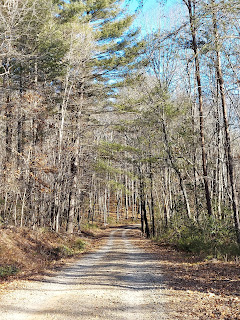
Path of hike in North Carolina

By no means do I have an astounding collection of handwritten work. What I do have are snapshots of the past. They tell me who I was at a time when I was wondering who I was. Sometimes, more often than I'd care to admit, my writing didn't go much beyond "no one will ever love me" (no winking here).

Recently, I flipped through a notebook in my drawer and picked a nearly blank one to find a poem I couldn't remember writing and the title of a book, which I've since read. Both notes to myself were several years old, both a remembrance of what was going on then, the life stuff, the good and the bad. Ironically, I just mentioned the name of the book to someone and went on to describe the gist of the story, which was darkly dystopian.

My point is: notebooks are like hieroglyphics, and mine are a mirror. Sometimes it's nice to see your old self; sometimes I wish I looked different.

Sunday, August 8, 2021

At A Crossroads

My next book is coming out, and the opportunity to move in a new direction is imminent.

The Book of Ulie by Jennifer M. Fulford
The conclusion of a book, in this case by publishing it, brings a sense of fulfillment, excitement, and letdown. Why letdown? Because the birth "process" is over. All the labor and worry about the way the story will unfold comes to an end. The process for The Book of Ulie took me more than seven years. Obviously, I wasn't working on the manuscript for a solid seven years. I started it and wrote it in about two, then put it aside for about four, then resurrected it to get it out of my system. Don't get me wrong. I have liked this book from the beginning A LOT. It's a good story. Catchy, infectious. (Even my mom liked it, and she's a hard reader to please.) The break from it was just life happening.

Readers may wonder: Is Ulie you? No and yes. No, she's not how I am as a person. Yes, she comes from parts of my experiences and thoughts. But, she's not the true me. I'd like to be more like her in some ways but not in others.

She's a writer, working on a book, and that's how I am now and always. My crossroads is: What should I do next? How should I change to broaden my audience? Should I write more for personal or commercial success? Ulie asks the metaphysical: Who am I? I guess I'm doing the same. 

Saturday, September 26, 2020

I Am Not a Scientist

I’m not a scientist. But I work among them. I see my job as interpreting. My words give a voice to the science that could be affecting you right now. And, it is. The world is changing, and I don’t mean politically. It’s about our atmosphere and the ocean and the carbon we’re putting and have put into both. This isn’t my attempt at a lecture. This is an essay about what I see in my everyday work.

I initially laughed a few years ago when a colleague of mine asked: “What’s a different way of saying ‘It’s the hottest ______________ (yr, month, quarter, day) ever?’” That description has been needed so much of late, it has become a cliché. You may have noticed it, too, where you live. Maybe not more heat. Maybe something is different than what it used to be: it’s drier, wetter, colder. Yes, colder. If snows are happening where they didn’t used to, it counts as odd to those who live there. The changes may simply dawn on you one day: This weather isn’t normal; it’s not what I remember.
International Space Station photo over Philippines

Many of the people I work with study these changes. They monitor temperature and precipitation trends, soil moisture, or jet streams. They tally extreme weather events. Some focus on very specific questions and fields of study. They use language and calculations that ordinary people, me included, don’t really have a working knowledge of. What I do comprehend is that we’re in uncharted territory. In a nutshell, the planet is warming. We know because observations of the world have been recorded since before your grandparents were born, even before there was an America (https://bit.ly/3b7Z5ro). This information has been handed down and then documented, on paper documents and in computers. Now, we can look at the records and determine where we stand. Where we stand today is a hotter place—global temperatures in some locations are consistently above normal. Carbon levels are higher than they have ever been on record. Independent large scientific organizations across the world agree with these assessment. We are still learning what this means in the long run, for our future in a different climate.
But, what is normal? Well, think of normal as a span of certainty, when conditions fell within a range and didn’t veer too far off center. Except now we’re veering off center, and in same cases dramatically. One place in particular, Alaska, which I think of as the canary in the coal mine, is significantly hotter. It just recorded its hottest year in 95 years, the length of the state’s official records. Alaska’s statewide average temperature last year was 6°F above average; Anchorage recorded its first 90°F day in 2019. Think of this in terms of your own temperature. On average, the average human temperature hovers around 98.6°F (though science says this is also changing). If you were to add a degree, over a short period of time, you’d feel it. Your systems wouldn’t work like they should.
Another cold place that’s bearing the brunt: the Arctic. A scientist I know told a national news reporter this summer he/she wanted to get to the Arctic as soon as the pandemic ended but before the ice melted. He/she had just published a paper that indicates the Arctic could be mostly ice-free in the summer within 15 years.
People in my professional life aren’t full of doom and gloom; they are heads-down engaged in the serious study of changes going on across the globe and in our backyards. In many cases, it is their life’s work. They have been working in their specialties since the beginning of their careers and will keep on, mostly out of the limelight, until they retire. Some of the scientists study things you and I will never actually see: carbon levels in the ocean, drought in South America; or incidence we don’t want to see: unprecedented flooding along our coasts, coral bleaching. They would probably never write an essay like this, not because they couldn’t, but because they are concerned with the science and the exactness of it. My take on things would not be scientific enough. No one from my work endorsed this post; nor did anyone review it. I have to state that because of the nature of my job.
What they aren’t doing is debating among themselves about whether any of these major changes are actually taking place. I could send you to reports that have been a year or more in the making, or monthly charts, or data tables of temperatures and precipitation and ocean conditions, but would those numbers and figures and science-making make a difference to your understanding? I’m not sure they would. That’s why I wrote this essay. To tell you, unequivocally, change is happening. How good are you with change?

Thursday, November 12, 2015

Intellectual Property Mashup

The internet is a black hole for artists. It's a copyright Bermuda Triangle.

This is such a convoluted topic, I'm almost too wary (and weary) to tackle it. Don't take any of my opinions as legal advice. If you, as a creative person, fear someone "stealing" your work, then take advantage of all your legal avenues to prevent it.

Here's my take: Once I put something out there, it's out there. I hope no one uses my work for profit without my consent, but there's no way in hell I'm gonna know every infraction. I do know some. I have a Google Alert set up for my book title. More times this year than I care to remember (probably six?), an alert has popped into my email box informing me that my book is downloadable for free on a site that doesn't have permission to distribute it for free.

It used to irk me. Now, I figure, maybe a few people will read it and like it enough that they'll actually buy something else I've written (or will write).

My house sits on a large lot. At one corner, three neighbors, whom I've yet to meet, place their trash on the very edge of my property for pickup each week. At first, this irked me, just like the free downloads. Now I see that it doesn't really harm me much. I've even thought about building an aesthetically pleasing trash bin for them to use. It's just a matter of being neighborly, in a way.

Are those free download sites making a killing off my download? Selling ads as an aggregator? I doubt it, but I don't know. Frankly, it doesn't harm me much. Or at least, if it does, I don't feel it directly. I worry sometimes when I find things on the internet that I want to use but can't find a way to properly credit the creator. It's not easy to know who created what online.

But my creative work is my work. I put hours and worry into it. I'm not going to give it away outright. Far from it. I'd like to make more money from it, but doing so isn't easy. My advice: Do what you can and when you can to keep your work protected. Then, let it go. It's going to be out there whether you double-down on surveillance or not.

For an overview of copyright issues for writers, see this post by Writer's Digest.


Monday, September 28, 2015

The Gift of Time

Writing needs the gift of time. It requires the potion of reflective idleness. If a book is to live, it must grow. If a book is to grow, it must be nurtured. It must have space and air to expand and contract. Air and space are the equivalent of time.

Two years ago this December, I finished the draft of my second book about Athos of The Three Musketeers, part of my historical romance trilogy. I've written other kinds of fiction, but this series has taken up tons of my head space. When I finished the second book, my idea was to let it sit for about three to six months to "rest." My crit group had read it, and two editors were lined up to review it.

Then my husband died.
Prequel to The Three Musketeers

So much for book two.

Unfinished projects drive me crazy. They morph into little clouds of gray, sitting above my shoulders. Grieving trampled my motivation for just about everything. My good intentions eroded. So did my bad intentions. All my intentions. It's getting better. All the well-meaning people in my life said it would. It does. It won't ever be the same, but the grief is not molasses like it had been. It's still sticky, sometimes, but not thick and dark, like it had been.

The book kept pestering me. I enjoyed writing it, maybe even a little more than the first one because I had less to learn about writing fiction. Not that I know it all. God, no. I just had the basics down. So, I let myself run a little faster, a little looser.

Book Two is better than book one. My opinion.

My two editors read it last year and sent editorial notes. I let them sit, too. I lost one set of notes in my email, then rediscovered it. A year ago, I read one editor's comments and laughed and laughed at his pokes. There was work to be done. It took another year, until a week ago today, for me to decide enough was enough. Time to shape up the manuscript. I thought it would take me several weeks. It took six days.

The work sat idle for almost two years. It annoyed my conscience, but it also worked out the kinks. There are probably still a few, but now that I'm on the other side of revisions, I like the book more. It's angst-y, sexy. Better than it was. I dumped a bunch of purple prose. I recalibrated the logic. It makes more sense. I WANT people to read it.

It'll be out by November. Besides bringing about a sense of elation and relief, it represents a turning point for me. I'm moving forward. Little by little. It reminds me that rest is good, and all can end, if not completely well, at least a little better.

Sunday, November 30, 2014

NaNoWriMo Winners, Congratulations on Self-Discipline

In my part of the country tonight, there's still time to finish the 50K-word novel and win the NaNoWriMo honor. National Novel Writing Month ends in about two hours on the East Coast, and certainly there are legions of chests bursting with appropriate pride for writing a novel in thirty days. Congratulations. I mean that sincerely though I didn't participate this year.

Despite it being a whipping boy for naysayers who call it a crap-fest, I believe the bones of the NaNoWriMo concept are good. It's an exercise in self-discipline, a necessary requirement for writers, one that usually is under-emphasized. Writers have to produce. In order to produce, they have to set goals and write on a regular basis. They should write every day. This is a stumbling point for many wannabe writers because it is so damn hard to do.

I am quite capable of explaining in agonizing detail the infinite (no exaggeration) ways in which things/life/distractions/people/natural disasters get in the way of my writing on a regular basis. Oh, hmm, how about, let's start with the easy stuff:

Housework (I cannot let my cat lick the dirty cereal bowls while I write, now can I?)
Mail (It may only come once a day and not on Sunday, but there's at least an hour of figuring out what to do with it.)
Repairs (My computer is flypaper to viruses; I must purge.)
Clutter (The very definition of my desk.)
Hairballs (See reference to cat in Housework.)
Blogging (I must write about why I'm not writing.)

Then there are the less obvious things that eat away at a writer's productivity. For me, something on the scale of small tragedy. Look away if you must, for these are not funny.

Death. (My husband died March 15.)
Loss of identity. (We were married for 20 years and together for 26. I spent more of my life with him than alone.)
Relocation. (By my choice, but nonetheless infused with hopes that didn't immediately materialize.)
Anxiety. (How do I become what I want to become, fashion a new life?)
Grace. (The state I am in, according to the grief counselor, therefore nothing else matters, including the writing.)

Please, do not feel sad for me. Feel encouraged tonight that scores of new stories were written this month by promising minds and that someday these books may find a way onto book shelves. I have hope my work will blossom again, too.

Wednesday, October 1, 2014

Take Stock, Moby Dick Lovers

This post has nothing to do with Moby Dick, other than I embrace the fact that I'll never finish reading it. On the other hand, here are few things in life I do embrace, not in any particular order:

rock'n'roll

the delete key

the malleable mind

JennifersCuff
My favorite cuff courtesy of Jerry Van Amburg.
chocolate

fire

forgiveness

a well-placed kiss

leather on skin

true love

miracles

libido

tweezers

the power of words

my voice as a woman

lists

the constancy of change

Tuesday, July 29, 2014

That Damn Little Thing

I confess. My book snubs the Oxford comma. I turned my back on the buggar early and didn't redeem myself in the final edits, except for a few places where I asked my publisher for the "extra" comma to be placed. I wish now I had included it everywhere. It's an old journalist's habit to leave it out. Blame my years in radio (where, hell, no punctuation is okay as long as the voiceover is coherent.)

Thank God the book is out. Thank God, and thank everyone who cared to share a kind word with me in this process. Thank God, everyone with a kind word, and all of you who will read my novel. Thank God, everyone with a kind word, all you readers, and the enthusiasts (good or bad) who will write me a review. (Even bad reviews are reviews. Don't go getting any ideas.) Thank God, everyone kind, all readers, all reviewers, and anyone who bothers to buy fiction nowadays at retail prices. Thank Amazon. Thank God for independent bookstores. Thank God for this cranky computer I put up with to continue to be a half-assed writer bent on following a dream. Thank God for dreams. Thank God, she, he, it, with a magic wand full of surprises, for I still surprise myself when I write, and it's been too long since I wrote.

Death sucks.

Death is the only permanent thing there is. Or maybe, the only other permanent thing besides death is the transference of hope. For that, thank humanity. Thank yourself.
On my doorstep. A real, live book.

Monday, June 30, 2014

The Asterik to My Book Release

My book is being printed and released this week by a traditional publisher after five years of writing, editing, querying, and patience. This should be a champagne moment. I drank champagne over the weekend. At a friend's wedding. I celebrated his moment and remembered my own wedding 21 years ago. The recent death of my husband makes the book release a little hollow.

I am happy about the book, that it will live outside my own imagination now. I am also sad. Sad because he should be here. He lived through my obsession over the book. He came up with the title. He read all the sex scenes and cat-called. He will not realize its success. He will not benefit from the fruits.

I did not dedicate the book to him. He was a little pissed about that.

He loved me. I loved him. Some of the realities of love fill the pages. Not literally about my life with him, but broader, involving the spectrum of human emotion. Some of it encompasses pain. How can we love another person without a little pain? Read it. You'll understand.


Sunday, February 13, 2011

Writing Is As Difficult As ...

In a writing workshop yesterday, we did a free write to the prompt: Writing is as difficult as ... 

The purpose was to reveal our natural diction. In seven minutes, my words, according to L. McKenna Donovan, revealed:

I write about relationships.
I write in the abstract.
My themes are absolute.
I write like a person in her 20s with experience beyond that age. (Translate: I cuss. Probably lean toward sarcasm.)

Now, to be a better writer, the idea is to *not* write characters using your natural diction because they aren't you. Okay, fair enough. I'll work on it.

BTW, if you want to know what I wrote, I might consider emailing that directly, if you ask nicely. I'm not posting it here.

Saturday, December 4, 2010

Blank Page, Take That

It was a word. Denizen. I remember using it in an essay I wrote after my first interview ever. The woman I interviewed was in her 80s, living in rural Missouri and remembered when electricity first came to her home.

I had locked myself in my bedroom and was sitting at my desk (which my mother still has), writing the essay about her life for a contest on rural electrification. I wanted a word to describe her, and that's the word I found: denizen. I loved it. It was cool. It was another way of calling her a resident, and it made me want to keep going, thinking myself clever and all.

All good writing advice says stay away from the thesaurus, and for the most part, I try to follow that advice. Denizen probably looked quite out of place in a 15-year-old's prose. But it was fun learning new words and using them. My mom said too many $2 words in my recent draft manuscript. I retooled. But a good word is worth a million bucks.

I write because it's fun and because I love words. And I like to take a blank page and make something out of it. It's about creating images. Which can be a trip. And reaching into a character's head besides your own. I'm not intimidated by the blank, white stuff. Give me a glowing screen or a lined notebook. And take that.

Thursday, October 7, 2010

Write = Yes, Edit = No

A postscript to my first entry. I lament about my process, not the writing. I think, like some new writers, the urge to edit while writing is super strong. Spreading out the story uncritically is a near impossibility. The advice is to not look back -- ARE YOU KIDDING?

So, to take a lesson from therapy (not that I'm in it now), compartmentalize. That's what I'll do. I am to sit the entire month of November and just write. NOT edit. Editing is the no voice inside. The voice that says, "Hey, what the hell are you doing? Have you totally lost your mind? That reads like sh*t."

Writing is yes. Glitter lotion slathered all over. Pour out an entire jar of honey and let it drip. Everywhere. It's like going to the grocery story with a full bank account after a fast.

The question is: Am I hungry?